Local guide · 8 min read
Protecting a Paradise Valley Estate From Water Damage: Stone, Millwork and Art
You protect a large Paradise Valley home the way the house itself is built: wing by wing, because each wing holds a different material and fails at a different joint. Stone over slab, custom millwork, art on the walls, a casita on its own line, and a septic tank under the lot each need their own check, and the plan is organized around what a leak would destroy, not around where it starts. Already see water, stains or a musty smell? Call (602) 671-3561. Or tell us what happened and someone from our team will call you back, and a local contractor goes over the next steps with you before you move anything.
01Good to know
The part most answers skip
An estate's water damage often starts away from where the family lives. It can start at the systems nobody walks past: a pool autofill valve stuck open, a casita water heater untouched for years, a supply line under travertine, a septic tank one pump-out past due. The plan here is built the other way from the household lists: it starts with the materials that cannot be replaced in kind, then works down to the valves.
02Local risk
Why does a large home fail differently than a smaller one?
It fails at scale and at distance. Paradise Valley is zoned mostly R-43, which means lots of at least one acre with one home per lot, according to the town's Residents Guide, so a house can sit well back from the meter with several water heaters, a casita, a pool and a septic tank strung along the way, each its own system with its own shutoff. In a smaller home one leak is one leak. In a large home the same leak can run for weeks in a guest wing nobody walks through, crossing a stone floor and a millwork wall before it reaches the art.
The first consequence is that the plan has to be written per wing, not per house. The second is that whoever closes the house for summer has to be able to shut down every wing, not just the main valve. A supply line that starts to drip in a closed house can work into a wall for a long time before anyone sees it. Arizona's monsoon season runs June 15 through September 30, set by the National Weather Service office in Phoenix.
03Good to know
Where does water enter a stone-floored estate first?
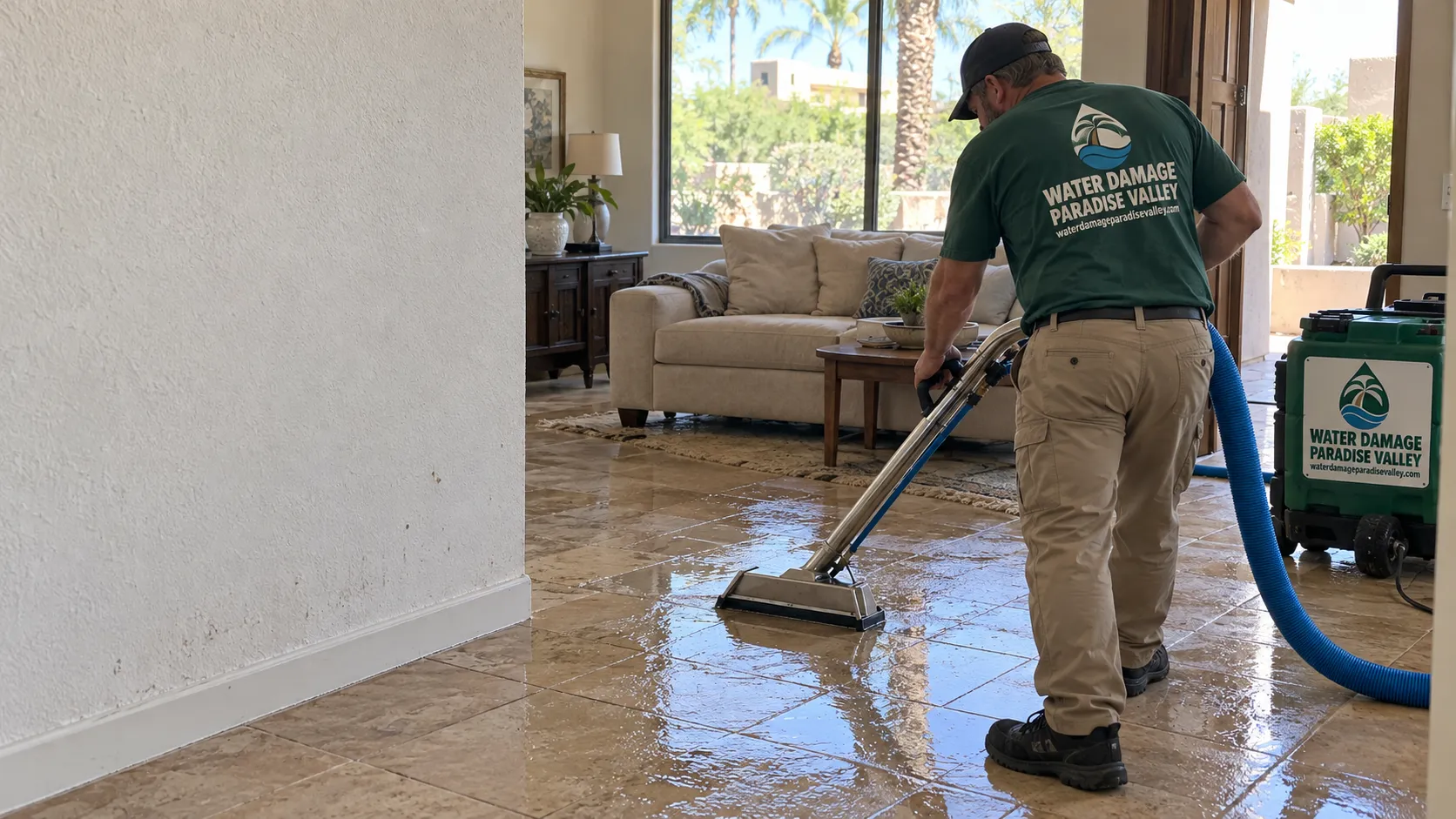
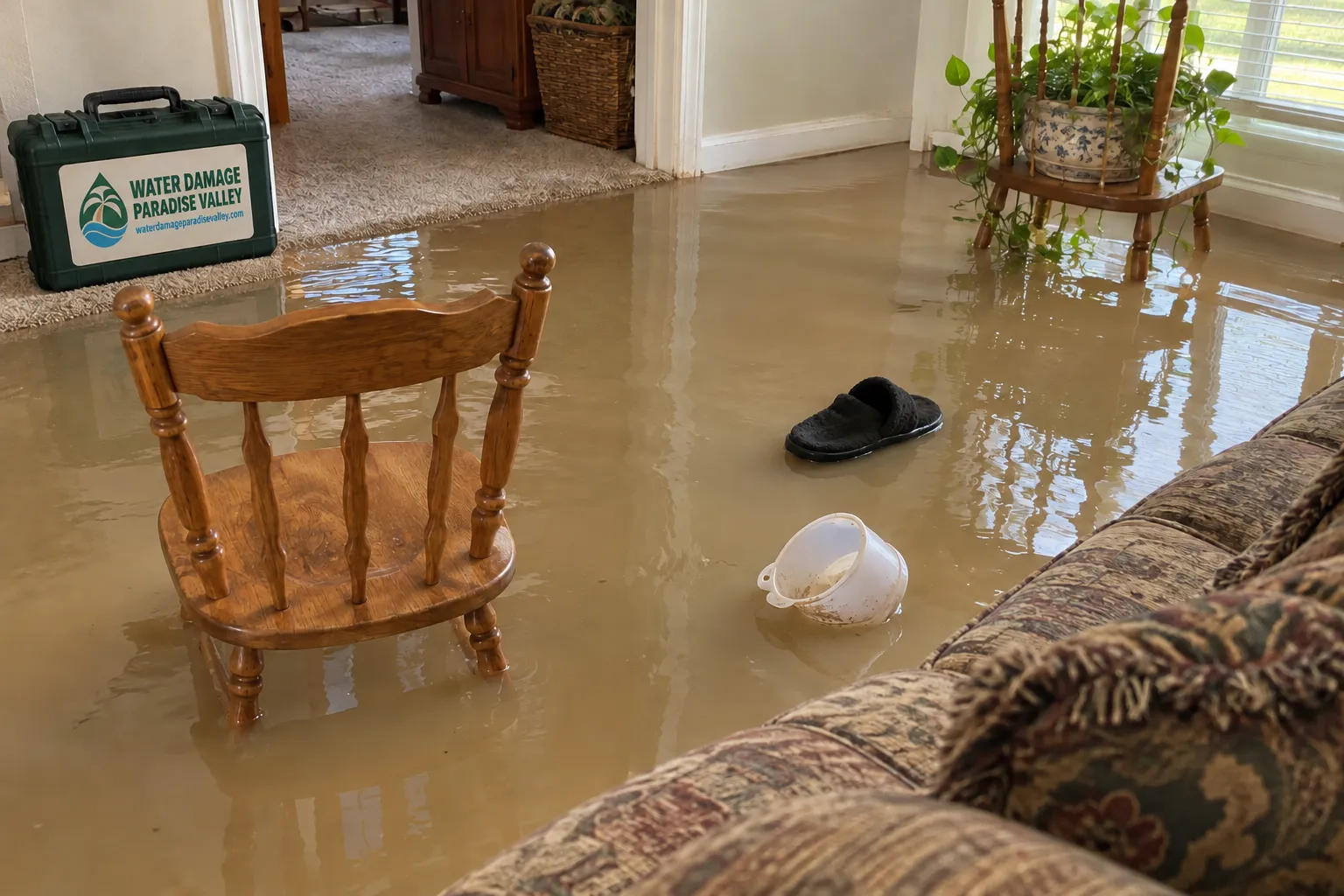
Often through the slab, not the roof. A supply line under the concrete is called a slab leak, and on a stone floor it is one of the quietest failures: the water goes into the ground and up through the slab, darkening the stone or the grout long before it pools anywhere. The early-warning version is the five detection methods list, ranked from the meter test to thermal imaging.
The other entry points are the appliances that live on the stone: the dishwasher, the ice maker, a pot filler, a wet bar. Each has a supply line that crosses the stone on its way to the wall, and a slow drip at the back of a cabinet can run under the stone for days and leave nothing on top of it.
04Good to know
What protects travertine and natural stone from a leak?
Sealant, grout, and knowing what the stone sits on. Travertine tolerates clean water: it forms from mineral-laden water and is commonly used in showers, so the stone does not soften the way drywall does. What fails is more often the layer under it. If the stone is set over a wood subfloor, the wood can warp and crack tile and grout. What evaporating water leaves behind also matters: a white haze called efflorescence, or a yellow cast from iron oxide in the stone, both of which can often be cleaned up if caught fast. The full keep-or-remove answer is on the drying travertine and hardwood page, and structural drying is the step that follows the water out.
In practice, protecting the stone means watching the grout lines, which can darken when water moves under the tile, and treating any darkening that does not dry as a sign that the subfloor or slab may be wet, not as a stain to ignore. Ask a stone contractor whether the stone needs sealing.
05How it works
How do you keep custom millwork and cabinets dry?
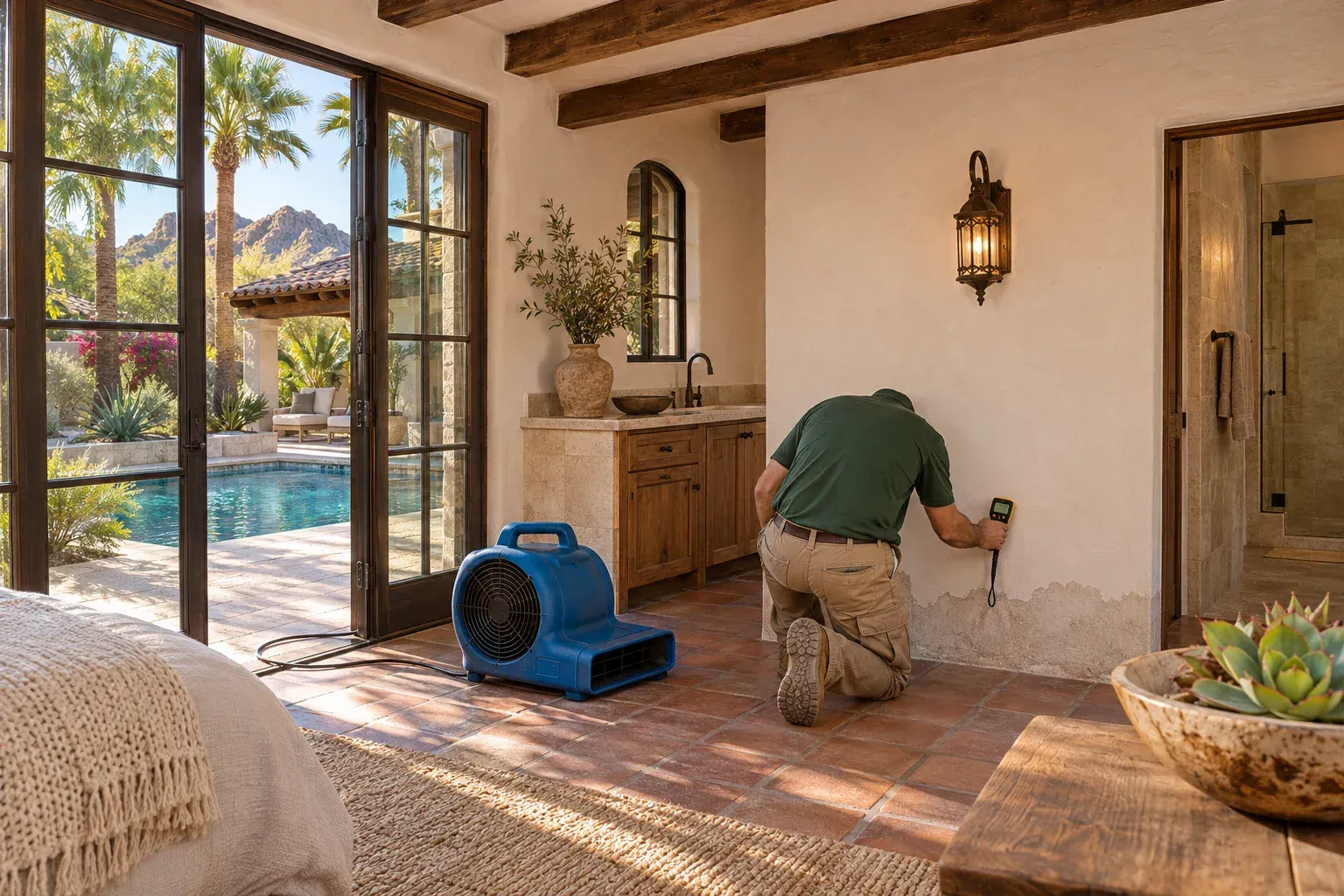
You check the fittings above them, because millwork can be damaged by a slow drip nobody sees. A supply line to a dishwasher, an ice maker, a pot filler or a bar sink runs through or above the cabinetry, and when one fails it can feed water into the top of a cabinet for a long time before it reaches the floor. By the time the toe kick swells or a veneer edge lifts, the water has been inside longer than anyone thinks.
The check is a hands-and-knees pass through every kitchen, bar, pantry and bath cabinet once a season: open the doors, look at the shelf under every supply valve, feel the back of the base. Ask a plumber whether the supply lines under the cabinets are due for replacement. The cabinetry is the expensive part, and it is cheaper to catch the drip at the fitting than to rebuild a run of matched millwork.
06Good to know
Where do art and rugs go before water arrives?
Off the wet walls and off the floor, before anything else moves. Canvas and paper can pick up moisture and mold behind the frame, so art comes down from any wall that shows a stain, a bulge or peeling paint, and from any wall a supply line runs behind. Large rugs stay put unless they can be lifted without dragging them through water.
The plan for a home with a collection should be written down: which pieces come down first, where they go, and who photographs each one before it moves. Anything too large to move gets photographed in place. Say early, when you call, that a room holds art, because that changes how the room is handled.
07Good to know
How do you protect a casita that sits empty?
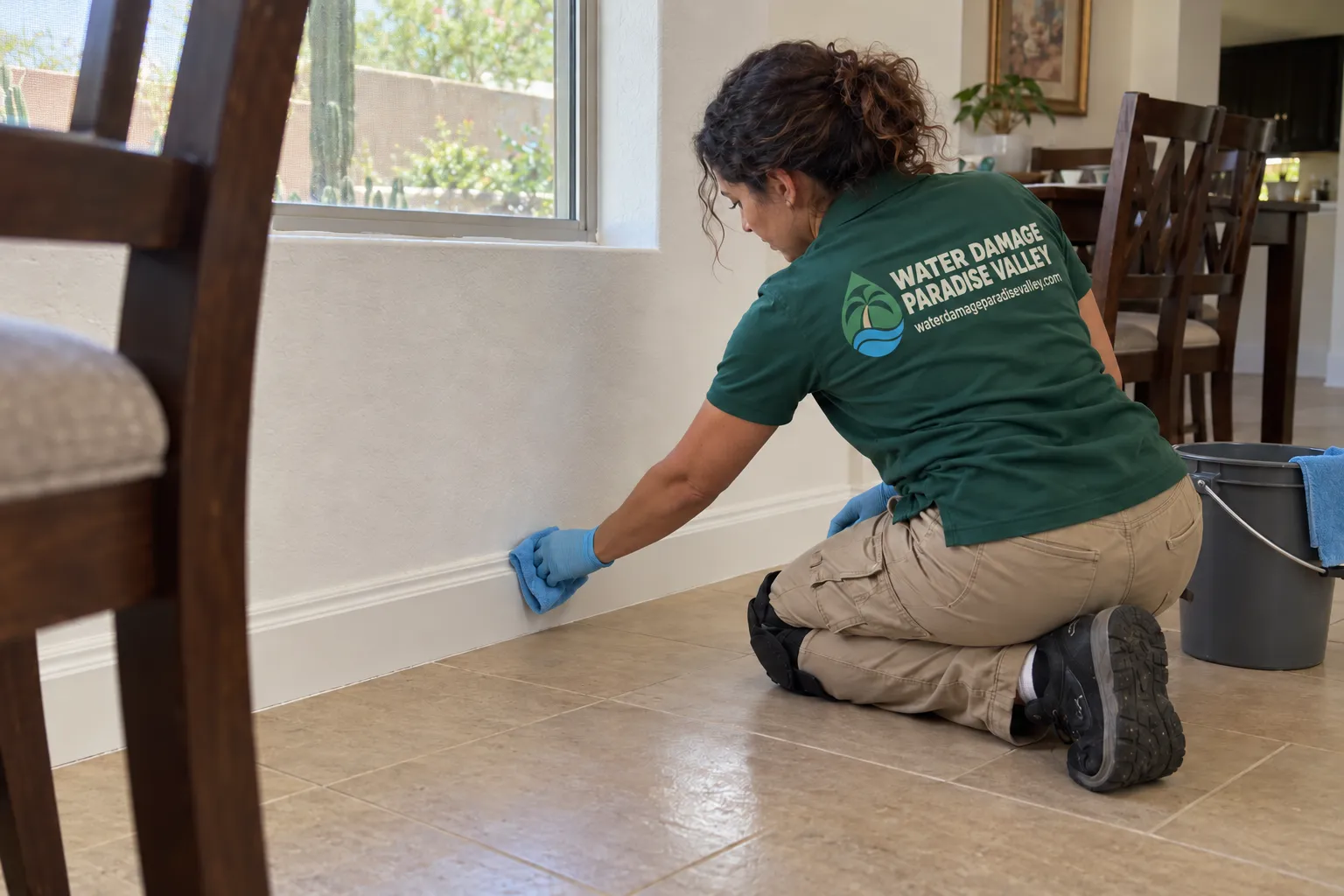
Treat it as a second house, because it fails like one. A casita or guest wing usually carries its own water heater and a dedicated supply line, and it is the structure nobody checks every day. The heater can leak unnoticed, unused bathroom plumbing can dry out at its fittings, and the condensate line on its own cooling unit can clog and overflow while the main house is fine. The casita and pool house page runs through where those leaks start and the monthly walkthrough that finds them.
The short version: every casita gets its own shutoff, marked, and its own leak sensor where the water heater and any laundry or wet bar sit. When the estate closes for a stretch, the casita water goes off first, not last.
08Good to know
What does a septic system need to stay out of the house?
A pump schedule and a set of early warnings, because a septic failure comes in as contaminated water. Homes in Paradise Valley that are not connected to a sanitary sewer have septic systems, according to the town's Residents Guide, and Maricopa County Environmental Services is the agency that regulates those onsite wastewater systems. The Environmental Protection Agency's septic guidance is to have the system inspected and the tank pumped on a regular schedule, because a full tank can push solids into the drain field and clog it.
The warnings come early if you know them: drains that slow across the whole house at once, a gurgle after the laundry runs, or a toilet that backs up once and then seems fine. Any of those is the moment to stop using water and get the system looked at before it backs up into the lowest bathroom.
09Good to know
What is the estate-wide shutdown plan?
A single sheet that names every valve on the property, because in an emergency the person standing in the water may not be the person who knows the house. Paradise Valley is served by four water providers depending on address, Berneil, the City of Phoenix, the City of Scottsdale and EPCOR, according to the town's Utility Services page, so the main shutoff location is not the same from house to house. The sheet writes down the main valve, each water heater's valve, the pool equipment breaker, and the irrigation controller.
Two habits sit on top of the sheet. First, a monthly read of the water meter with everything off; movement means water is leaving the system somewhere. Second, a flow monitor at the meter that alerts a phone when water keeps running, a tool that can catch a leak in an empty wing. If the house is older, know the pipe material too: polybutylene pipe was installed in up to 10 million US homes and made from 1978 to mid 1995, and InterNACHI reports it can flake apart when disinfectants in the water act on it. A property that mixes a home with a detached office or a space that earns money can fold in the commercial water damage plan for that building.
10How it works
Next step: build the plan around this house
What decides the answer for a specific estate is the water source, the material it would hit, and how long it has been wet. A supply line dripping above stone is a different risk from a slab leak under travertine, and a casita that sat wet for a month is a different job from a wet bar caught the day it happened. The EPA's guidance is to dry water-damaged areas and items within 24 to 48 hours to prevent mold growth, which is why the shutdown sheet and the monthly checks matter more than any single gadget.
A local contractor confirms the plan on site, because the valve map has to match the actual house. Tell us what the property holds, where the water could come from, and which wings sit empty, and a local contractor helps you plan the room-by-room pass before anything gets wet.
Already see water, stains or a musty smell? Call (602) 671-3561. If water is running right now, shut the main valve and read the first 24 hours page for the order of moves, or send the form and someone from our team will call you back.
113 questions
Questions people ask
Still have a question?
Call and describe what you see. Calls are answered day and night.
Call (602) 671-356101Does homeowners insurance cover a slab leak in an estate?
It depends on the cause and the policy, and the insurer decides. Ask the insurer or agent how the policy treats accidental discharge from plumbing, long-term seepage and flood water, because flood is usually a separate question from a standard homeowners policy.
02Should a large home have one leak sensor or several?
Several, placed where each wing fails: under the main-house water heaters and sinks, at the casita water heater, and anywhere a supply line runs above millwork. A sensor only helps where water reaches it, and the systems that fail first are the ones far from the family room.
03How often should a septic tank be pumped?
On a schedule set by the tank size and the household, not by a calendar guess. The Environmental Protection Agency says to have the system inspected and the tank pumped regularly so solids do not reach the drain field, and the right interval is one a septic service confirms after a look at the tank.
12Sources
Sources
- 01Town of Paradise Valley, Residents Guide
- 02US EPA, A Brief Guide to Mold, Moisture and Your Home
- 03InterNACHI, Polybutylene for Inspectors
- 04US EPA, How to Care for Your Septic System
- 05Maricopa County Environmental Services, Onsite Wastewater Forms and Applications
- 06National Weather Service Phoenix, Monsoon Awareness Week
- 07Town of Paradise Valley, Utility Services
Last checked: November 2026