Service 07 of 07 · Paradise Valley, AZ
Mold Remediation and Removal in Paradise Valley, AZ
You have a musty smell, dark spots near a leak, or a room that stayed wet too long. Moisture mapping, containment and removal come first. Call day or night, or send the form, and someone from our team will call you back soon.
Paradise Valley · Scottsdale · Phoenix · Tempe · Fountain Hills · Cave Creek
01What you get
Mold confirmed, contained, removed and verified
Mold work in Paradise Valley almost always starts with water: a slow supply line, a monsoon leak, a home that sat closed through the summer. Growth is confirmed, contained, removed and verified with readings, and the water source is handled first, because growth returns until the moisture stops.
- The moisture mapped and the water source handled first, because growth returns until the moisture stops
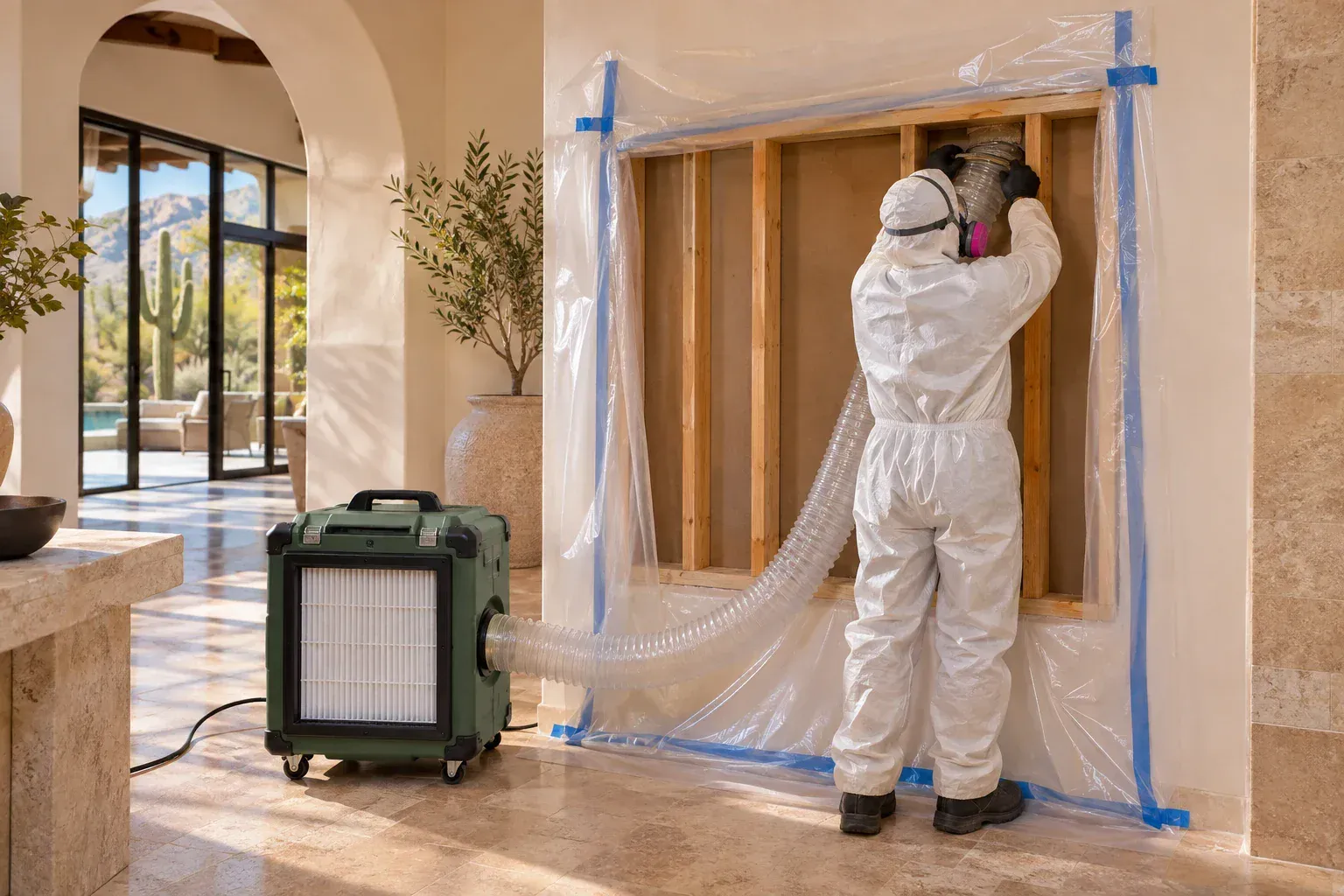
- Plastic barriers, negative air pressure and air scrubbers that keep spores inside the work zone
- Moldy porous materials removed and bagged inside the containment, hard surfaces HEPA vacuumed and cleaned
- The structure dried and re-read until every mapped point meets the dry standard
- A final walkthrough that compares the last readings with the first ones
02Warning signs
5 signs you need mold remediation
- 01
A musty, earthy smell
strongest in rooms nobody opens often.
- 02
Dark spotting, staining or a fuzzy patch
usually around a leak or a window, though not every dark stain is mold.
- 03
Baseboards that swell or separate, paint that bubbles
the moisture is often hidden behind the wall.
- 04
A soft spot underfoot
a quieter sign that matters as much as the smell.
- 05
A smell that disappears when the AC runs and returns when it stops
that points at the air handler or the ductwork.
03How it works
Three steps from the first call to a verified dry space
- 1
Call or send the form, day or night. Tell us where the water came from.
- 2
Someone from our team calls you back. We go over what happened and what comes next.
- 3
Containment, removal and drying follow. The area is contained, materials that cannot be cleaned come out, and readings verify that the space is dry.
04Costs
What does mold remediation cost in Paradise Valley?
The number is driven by how much area is affected, where that area sits, and what has to come out of it. The real number comes after an on-site assessment that includes readings, not just a look. The walkthrough is what turns a guess into a number, and the number is the one that matters to a budget.
05Good to know
What is mold remediation?
Mold remediation is removing mold growth and fixing the moisture behind it, in that order of thinking but the reverse order of doing: the water source gets handled first, because growth returns until the moisture stops. The full chain runs: find the moisture, stop it, contain the affected area, remove materials that cannot be cleaned, clean what stays, dry the structure, and verify with readings that the space is dry and the growth is gone. It is not spraying a surface and it is not a paint job. The EPA's guidance is direct on this point: mold has to be removed, not just killed, because dead mold can still cause reactions in sensitive people. The process ends with proof: readings that show the space is dry, signed off before anything gets rebuilt.
06Local risk
Why do Paradise Valley homes get mold?
The same reason they get water damage: age, quiet stretches and storms. The town's median home was built in 1985, and 42% went up before 1980, so decades-old supply lines and drains are the quiet majority here. Many homes sit closed through the hot months, which gives a June drip until October to work into a wall before anyone smells it. Monsoon season, June 15 to September 30, adds wind-driven rain against hillside roofs and low doorways. Add pool and fountain lines, long private service runs, and septic systems on some lots, and the moisture sources multiply. Desert air does not prevent any of it; the mold only needs the wet spot, and this town has plenty of ways to make one.
07Warning signs
What are the signs mold is growing?
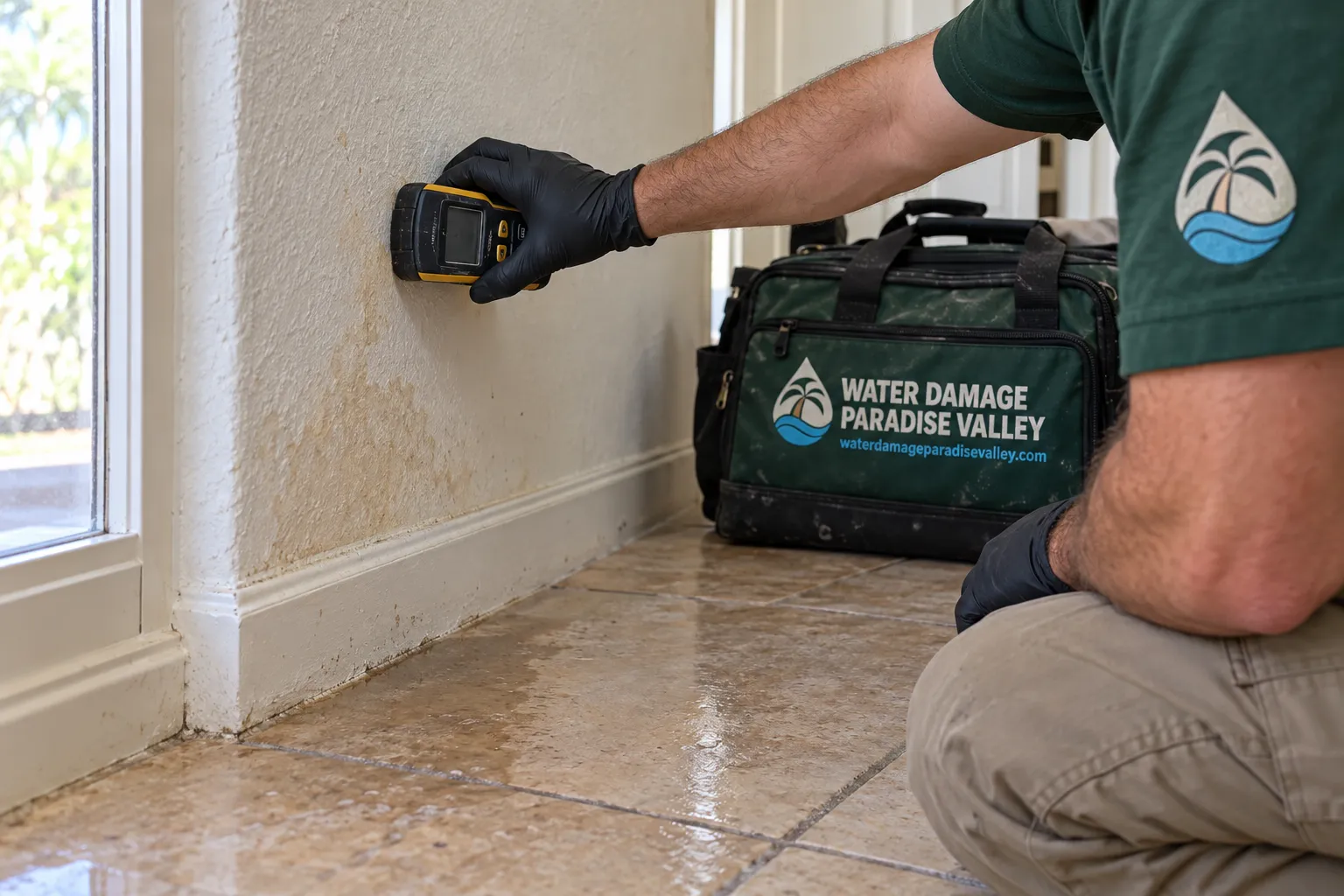
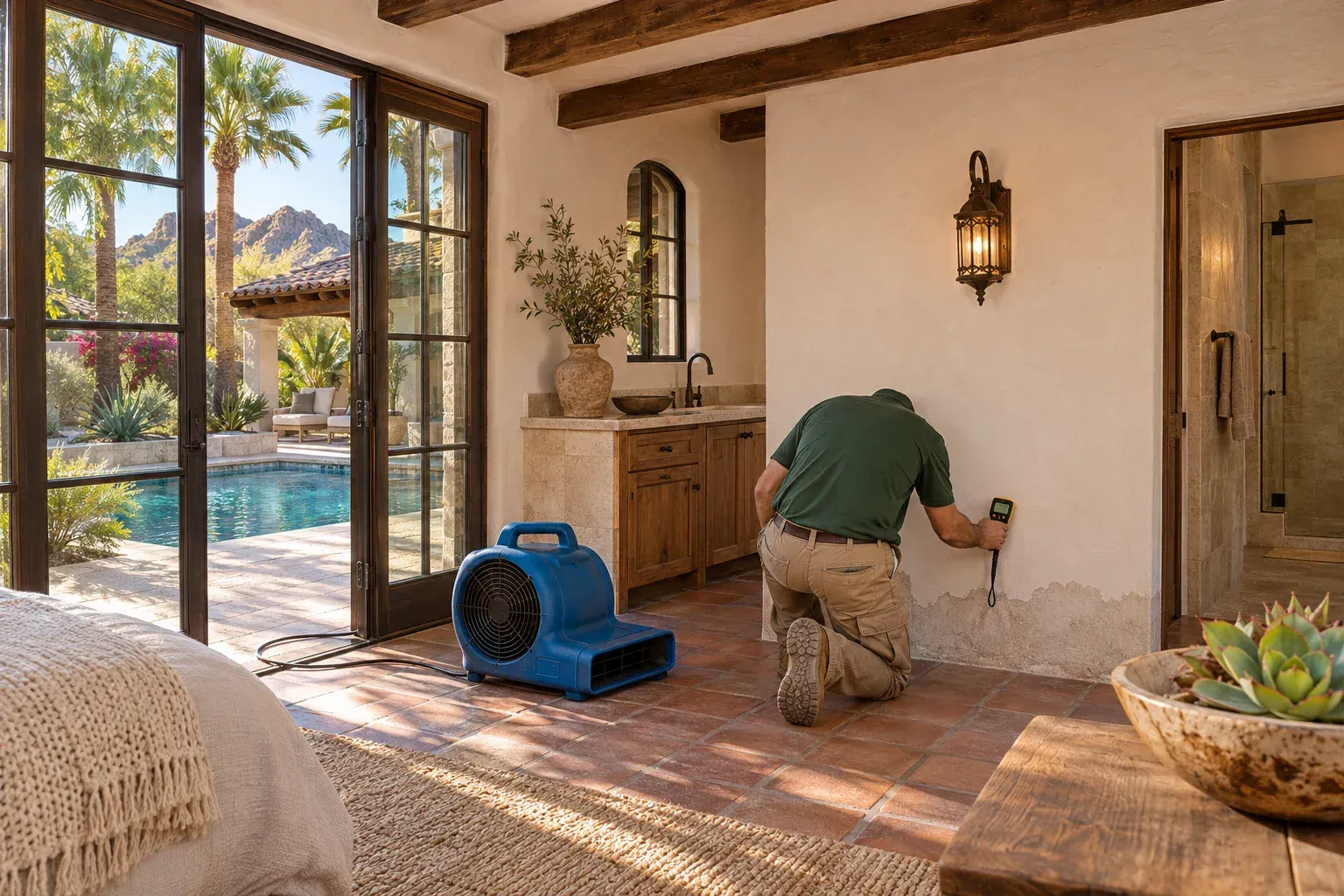
A musty, earthy smell is the most reliable early sign, and it is strongest in rooms nobody opens often. Growth usually shows as dark spotting, staining or a fuzzy patch around a leak or a window, though not every dark stain is mold. The quieter signs matter as much: baseboards that swell or separate, paint that bubbles, a soft spot underfoot, or a smell that disappears when the AC runs and returns when it stops, which points at the air handler or the ductwork. Because the moisture is often hidden, the smell is the trailhead. Testing identifies what is actually there; a moisture meter finds where it is feeding from. Both details matter here: locating the moisture decides the plan, and testing decides only the name.
08First steps
What should you do in the first 10 minutes?
Do not panic-clean, and do not scrub. Wiping growth spreads spores into the air, and it also destroys the evidence the inspection needs. Keep people and pets out of the affected room, especially anyone with asthma or allergies. If water is still running, shut off the main valve or the fixture. If the air handler or ductwork might be involved, keep the HVAC system off, which is what the EPA advises. Photograph the growth, the stain and the source from a few steps back, then call (602) 671-3561 and describe what you see and smell, including when the wet event happened. That timeline decides how the first visit runs. Write down the time; the plan gets built around it. Everything after gets easier with that one detail on record.
09Good to know
When is cleaning enough, and when is it a professional job?
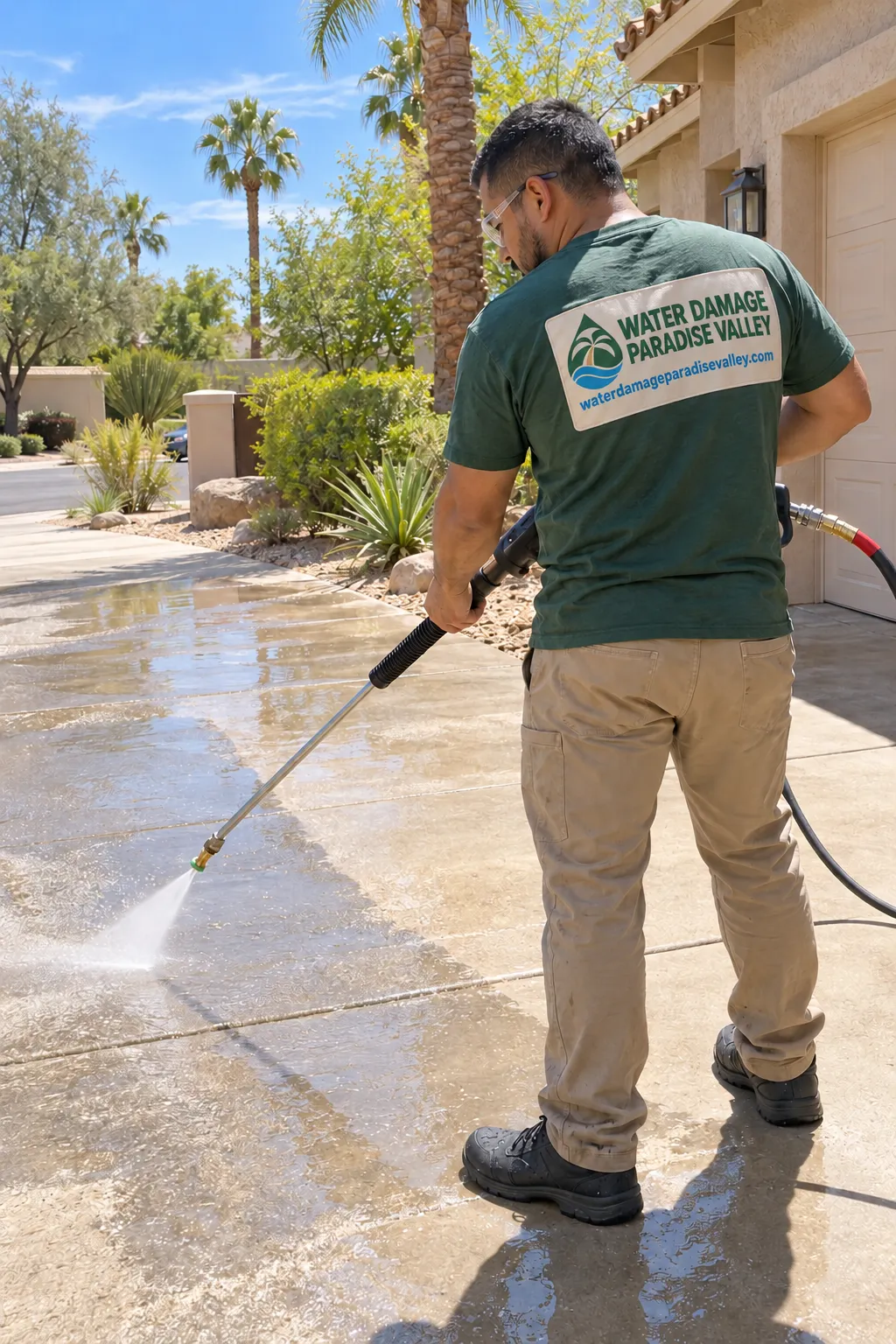
The EPA's practical line sits at about 10 square feet on a hard, non-porous surface with no sewage involved: below that, and after the water source is fixed, a homeowner can reasonably clean it. Past that line, or anywhere the growth sits inside a wall, under flooring, in an attic, or in HVAC equipment, it is professional work. Three more triggers push it contractor: the smell returns after cleaning, the area stayed wet beyond 48 hours, or porous materials like drywall, carpet and insulation are involved, because those cannot be cleaned back to safe, they can only be removed. One more line for homeowners: if the smell is strongest when the AC stops, treat the system itself as a suspect before anyone cleans a wall.
10How it works
What does the remediation process involve?
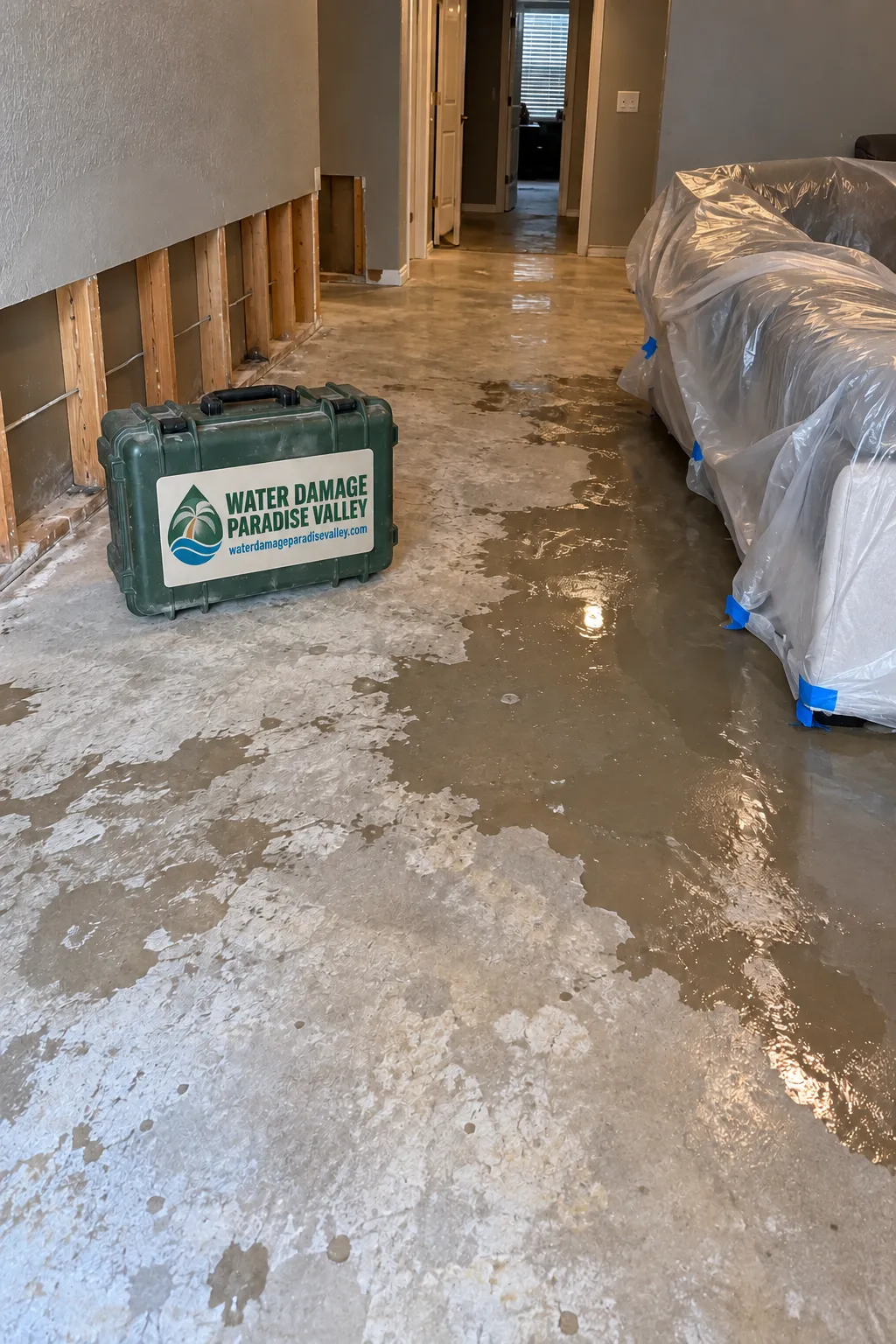
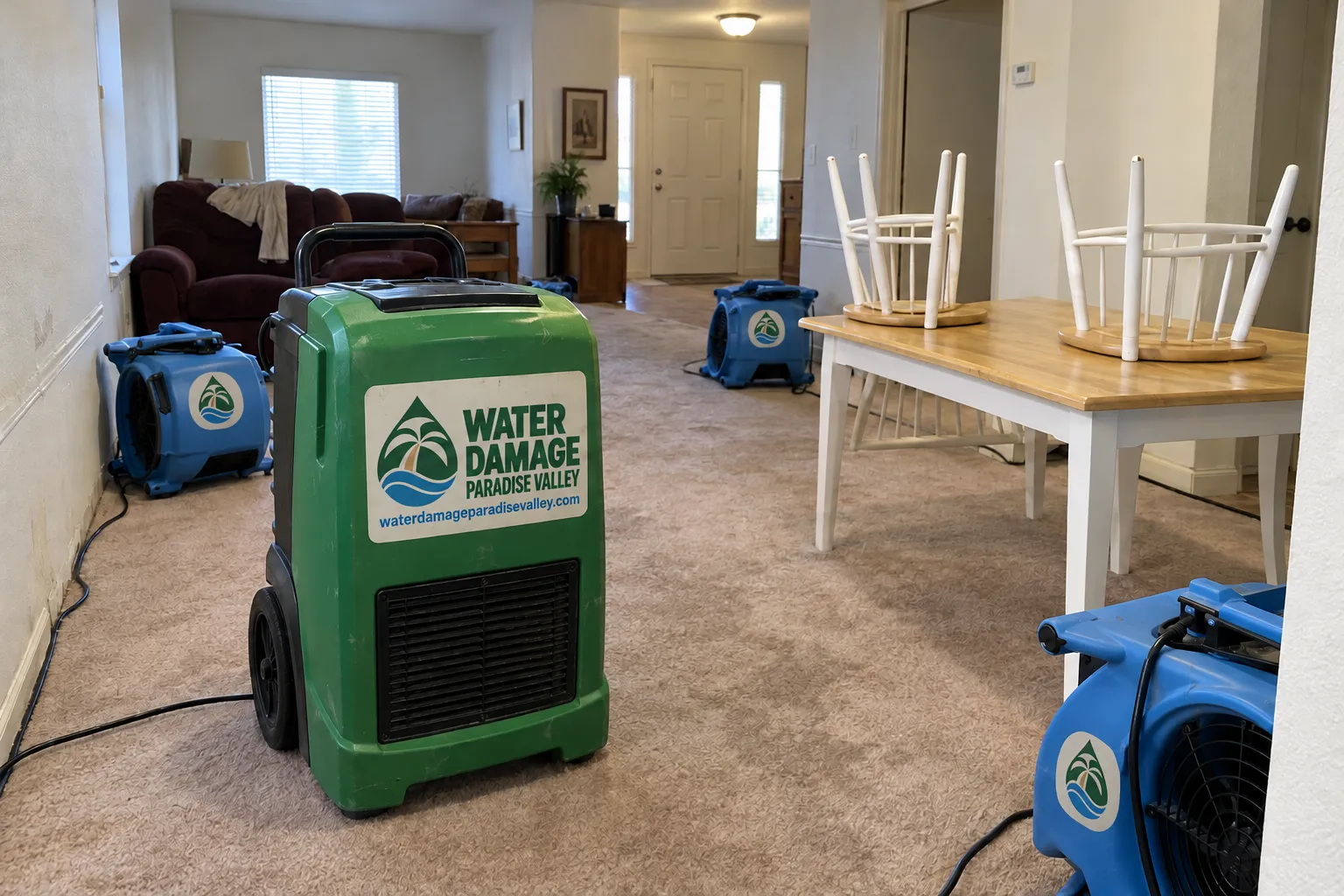
Most jobs move through the same steps. First, the moisture map: readings across the affected area and the rooms around it, so the dry standard has a baseline. Second, the water source gets fixed, by a plumber or a roofer, before any cleaning starts. Third, containment goes up: plastic barriers and negative air pressure, so spores stay inside the work zone, with air scrubbers filtering what the space exhausts. Fourth, moldy porous materials come out, bagged inside the containment. Fifth, hard surfaces get HEPA vacuuming and cleaning. Sixth, the structure gets dried and re-read until every mapped point meets the dry standard. The final walkthrough compares the last readings to the first ones. The sequence is the same on every job; the sizes are what change. A bathroom is a contained day. A whole home is a project.
11Drying window
How long does remediation take?
It depends on the spread and on the water source. A single contained area can be removed, cleaned and dried in a couple of days. Attic jobs, ductwork, and anything that requires demolition and rebuilding take longer, and nothing should start while a leak is still running. Plan three phases in order: the removal and cleaning work, the drying that readings have to prove, and any repairs after. A single fixed number quoted without seeing the space is a guess; the on-site assessment is what produces a price and a schedule.
12Insurance
Does insurance cover mold removal?
It depends on the policy and on how the water got in, and the insurer decides. The classic covered event is a sudden, accidental plumbing failure; long-term seepage and floodwater usually are not covered, and flood needs its own policy. The practical move is the same either way: document early and keep the paperwork together, photos, dates, readings. The Triple-I (opens in a new tab) explainer walks through how homeowners coverage treats water losses, and it is worth reading before the adjuster conversation, not after. If the policy carries a mold cap, find that number early, because it shapes the plan from day one. Keep your own copies of everything, too; the side that documents first argues least later. Start with those two facts, the cap and the file, and the rest of the conversation gets easier.
13Good to know
How fast does mold start after a water event?
Within a day or two, if materials stay wet. The EPA sets the drying window at 24 to 48 hours, and that deadline is why water damage work and mold work are two ends of the same job. Past the window, the question is no longer whether growth started but where. The practical response in a Paradise Valley home is a moisture read after any leak that took more than a day to find, especially in homes that sat closed, because those are the ones where the window is gone before anyone walks in. Water work and mold work sharing one number is the point; the handoff between them is where jobs usually get dropped. One number for both halves, one file for both scopes.
14Service area
Which areas do you cover?
Paradise Valley first, then the towns around it: Scottsdale, Phoenix, Tempe, Fountain Hills and Cave Creek. The service areas page lists each one with its local picture. Mold work runs across all of them, and the differences are small but real: older plumbing and closed-up homes in Paradise Valley and Scottsdale, desert soils and caliche near Tempe foundations, high-ground runoff in Fountain Hills, and flat roofs in Cave Creek. One call covers all of it, day or night. A 10 minute call is usually enough to sort coverage, timing and the first visit. If the address sits between two town lines, that is normal here; the coverage answer does not change at the boundaries. Every town page carries its own local detail, so the plan can start before the crew arrives.
155 questions
Questions people ask
Still have a question?
Call and describe what you see. Calls are answered day and night.
Call (602) 671-356101How do I know it is mold and not just a stain?
A musty smell is the giveaway; plain water stains do not smell and do not grow. If you want certainty, testing identifies what is actually there. Do not scrub it first; that spreads spores and removes the sample.
02Can I stay in the house during the work?
Usually yes. Contained jobs run with the family at home and the work area off limits while equipment runs. After sewage or flood water, the affected areas change the calculation, and the call is a safety decision.
03Who fixes the leak that caused it?
A plumber or a roofer owns the source repair; remediation starts as soon as the water is stopped. The two work side by side, and the order matters, because mold returns to a wall that keeps getting fed.
04Do you check the AC system too?
When the source points that way. Growth around an air handler or in ductwork is its own problem, because a running system spreads spores. If the smell is strongest when the AC stops, say so when you call.
05Is the work documented for the insurance claim?
Yes. Photos, readings, moisture maps and daily logs are part of the job file from the first visit, organized the way adjusters ask for them.
16Keep reading
- All services: every service for Paradise Valley and the corridor towns.
- Emergency water extraction: the first step when water is still active.
- Structural drying: how the structure gets verified dry.
- Mold and wash clock: how many hours wet materials have before mold can start.
- Commercial water damage: when the building is a business.
- All service areas: Paradise Valley and the 5 towns around it.
- Mold Remediation vs Mold Removal in Paradise Valley:
- Repair vs Replace Wet Flooring in Paradise Valley: