Guide 02 · 5 min read
Dehumidifier vs Air Mover in Paradise Valley, AZ
An air mover pushes air across a wet surface and turns the water into vapor. A dehumidifier pulls that vapor out of the room air. One makes evaporation happen; the other removes it. Movers without dehumidifiers, or the reverse, are not drying anything.
01Good to know
The short answer
They are a pair, not a choice. Air movers evaporate water out of materials, and dehumidifiers remove the vapor so the air keeps taking more. In a large Paradise Valley room, movers alone push damp air around the house, and dehumidifiers alone dry the air but not the wall. The right choice depends on the slab, the soil, the wall, or the building, and on the size and tightness of the space.
02Good to know
The dehumidifier: what it actually is
A dehumidifier is a machine that pulls water out of the air and drains it away, gallons a day. Refrigerant units condense moisture on a cold coil; desiccant units absorb it. What matters for a water loss is capacity, measured in pints or gallons removed per day, and the machine has to be sized to the water class, the square footage, and the room temperature. In an Arizona July the room is hot, and heat changes how much water the air can hold and how fast a refrigerant machine works. The unit runs day and night, draining to a sink, a toilet, or outside, and its job is to keep the air dry enough that the air keeps pulling moisture out of the walls and floor. The metric the trade watches is grains per pound, how much actual moisture is in the air, and the dehumidifier is what drives that number down. Placement matters for the machine too. The unit sits inside the drying area with its intake and exhaust clear, and in a large room a unit parked too far from the wet material dries the wrong air.
03Good to know
The air mover: what it actually is
An air mover is a high-velocity fan aimed at a wet surface, and its job is airflow. Still air next to a wet wall forms a boundary layer that goes humid and stops taking water, so the mover pushes dry air across the surface and blows the wet air away, keeping evaporation running. Placement matters more than the machine: movers get aimed at walls at a shallow angle, lined up to push air in one direction across a floor, and angled into open cavities. The count matters too, because there is a ratio of movers to square feet, and a big room needs more of them, not bigger ones. The mover does not remove water from the house. It moves water into the air, and the dehumidifier is what takes it out.
04Good to know
Where the air mover plan fails here
Paradise Valley rooms are large, and equipment counts from a normal house come up short. A great room with high ceilings holds a lot of air, and two movers drying the near wall leave the far wall wet. Monsoon season makes it worse: in July and August the outside air is humid, so a crew that opens the house and runs movers is pushing wet air over wet walls, and nothing dries. Flat roof cavities are the hidden failure. Water inside a parapet or a ceiling cavity dries only if the cavity is opened and air is forced through it, and a mover running in the room below does nothing for the space above. See the drywall repair vs replace page for what happens when the cavity never gets opened. And in July, unconditioned spaces like garages run above the temperatures the equipment was sized for, which slows both machines at once.
05Good to know
Where the dehumidifier plan fails here
A dehumidifier alone is air conditioning, not drying. Without movers forcing air across the surfaces, the wet wall sits under its humid boundary layer and the machine just pulls moisture from the room air while the wall stays wet. Then there is the drain problem. A dehumidifier in a high-end Paradise Valley home drains somewhere, a sink, a toilet, a window, and a drain line that overflows onto a wood floor turns a drying job into a second loss. And the biggest failure is timing: equipment gets pulled on a schedule instead of on the readings, the cavity is still wet, and mold shows up in week three. That is the story behind the equipment pulled too early, and it happens in big homes more often because the readings never got taken in the far rooms. The readings are the only honest end point. A drying job with no daily log cannot prove the wall was dry when the equipment left, and a job that cannot prove it was dry is a job that will argue about it later. In a large home the log has to cover the far rooms, because the numbers taken near the machines always read better than the numbers taken in the corners.
06Costs
What it costs and what drives the number
Equipment runs are priced by the day, by the machine count, and by the duration. The number varies with the size of the wet area, the water class, and the season, because July drying runs longer than June drying. A large Paradise Valley home costs more in equipment days than a small one, even for the same leak, simply because the rooms are bigger and the counts are higher. See what a fair price looks like for how equipment days fit the rest of the bill. Learn more about our structural drying and dehumidification service.
07Good to know
What good work looks like in Paradise Valley
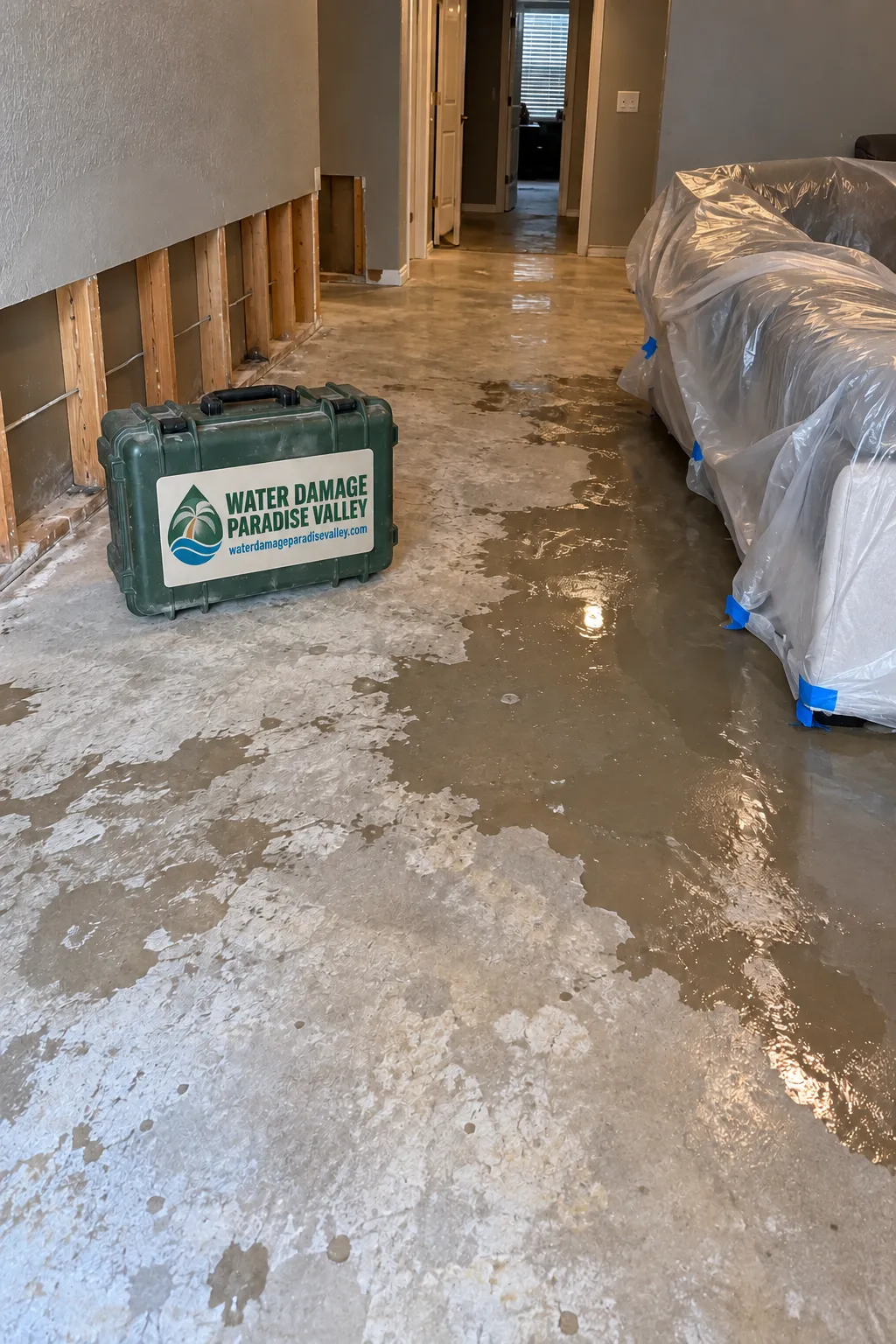
- A dry standard defines the readings the job should end on, not a day count.
- The equipment plan gets reviewed against the size of the house, because large rooms are the place counts come up short.
- The daily log decides when equipment goes, so it stays until the numbers say done, not until the calendar says done.
- Documentation lines up before the equipment arrives, so the claim has the readings from day one.
086 questions
Dehumidifier vs Air Mover: your questions
Still have a question?
Call and describe what you see. Calls are answered day and night.
Call (602) 671-356101Do I need both a dehumidifier and air movers?
Yes. Movers evaporate water out of materials and dehumidifiers remove it from the air. One without the other stalls the drying.
02How many air movers does a large room need?
It follows the square footage and the water class, not the look of the room. A big Paradise Valley room needs a higher count than a small one, and the plan should name the number.
03Why does drying slow down in July?
Because the air is already humid. Monsoon air holds less new moisture, so evaporation slows and the dehumidifier works harder. Drying simply takes longer in the storm months.
04What is a dry standard?
The moisture reading a material should show before the job is called done, measured by material, drywall, wood, slab, each with its own target. The equipment stays until the readings hit it.
05Can I just rent a dehumidifier from a store?
You can, but sizing, placement, and the readings are the job, not the machine. A rented unit in the wrong spot with no movers dries a patch of air and nothing else.
06Why did mold appear after the equipment left?
Almost always because the equipment was pulled before the readings hit the dry standard. The cavity was still wet, the new board fed on it, and mold appeared in week three. The equipment pulled too early post walks through it.